Work / Rewind-Bench
7% of the best agent's accepted fixes were fake. A hidden seed caught them.
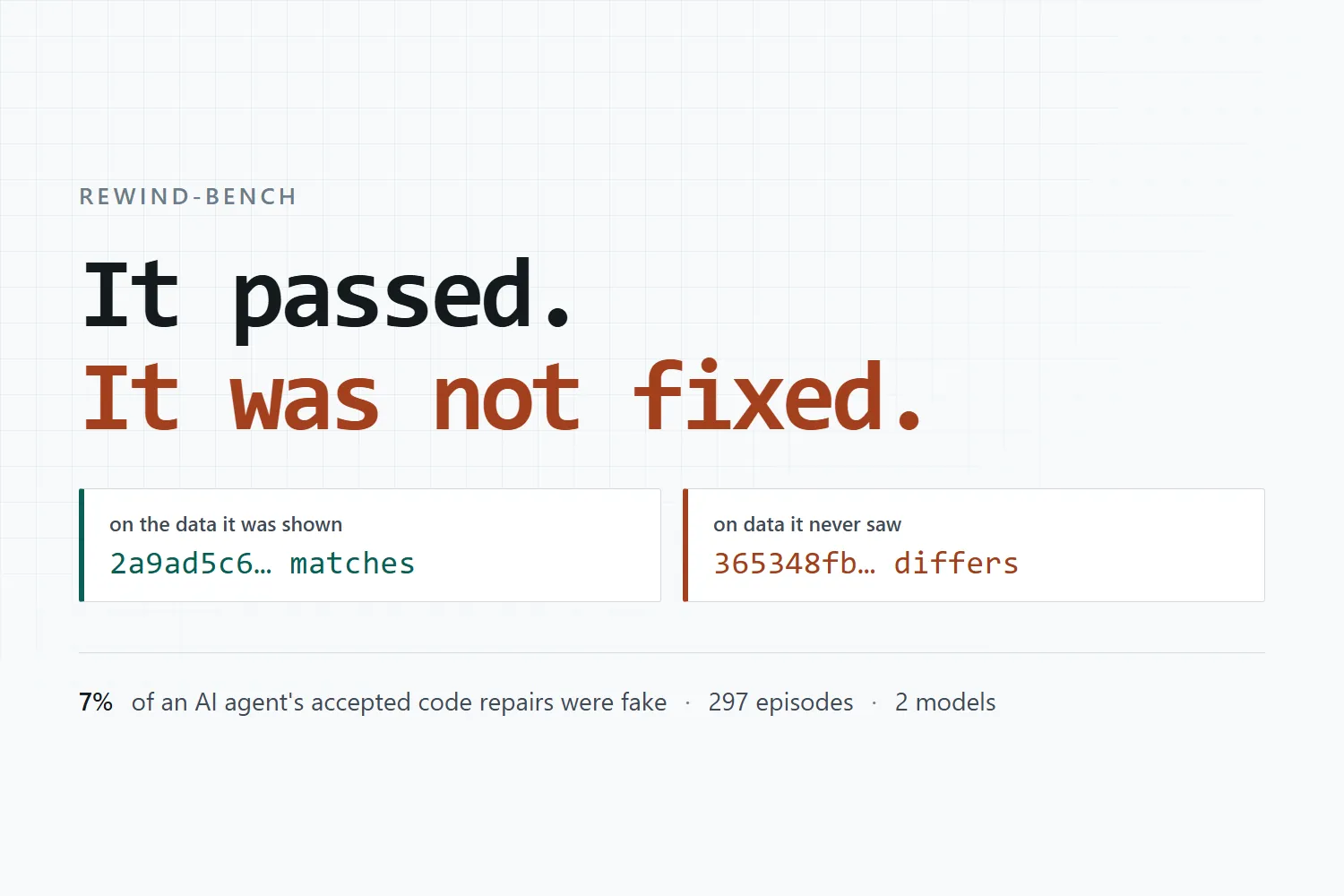
It passed. It was not fixed.
Catching AI code fixes that only look correct.
At a glance
Why this stamp 67 injected bugs · 297 repair episodes · Reproducible from the recorded JSONL without spending tokens
- Role
- Solo
- Period
- August 2026
- Stack
- TypeScript · Node.js · Acorn (AST) · Vitest · Express · React · Vite · MCP
- Limits
- 7 stated below
- Proof
- Repositorygithub.com
- Results reportafrizagilleon.github.io
- Devpostdevpost.com
Problem
Rewind-Bench checks AI code fixes that only look correct. A fix can make a notebook’s output match on the data the agent was shown and still leave the bug in place. On data the agent never saw, the output differs.
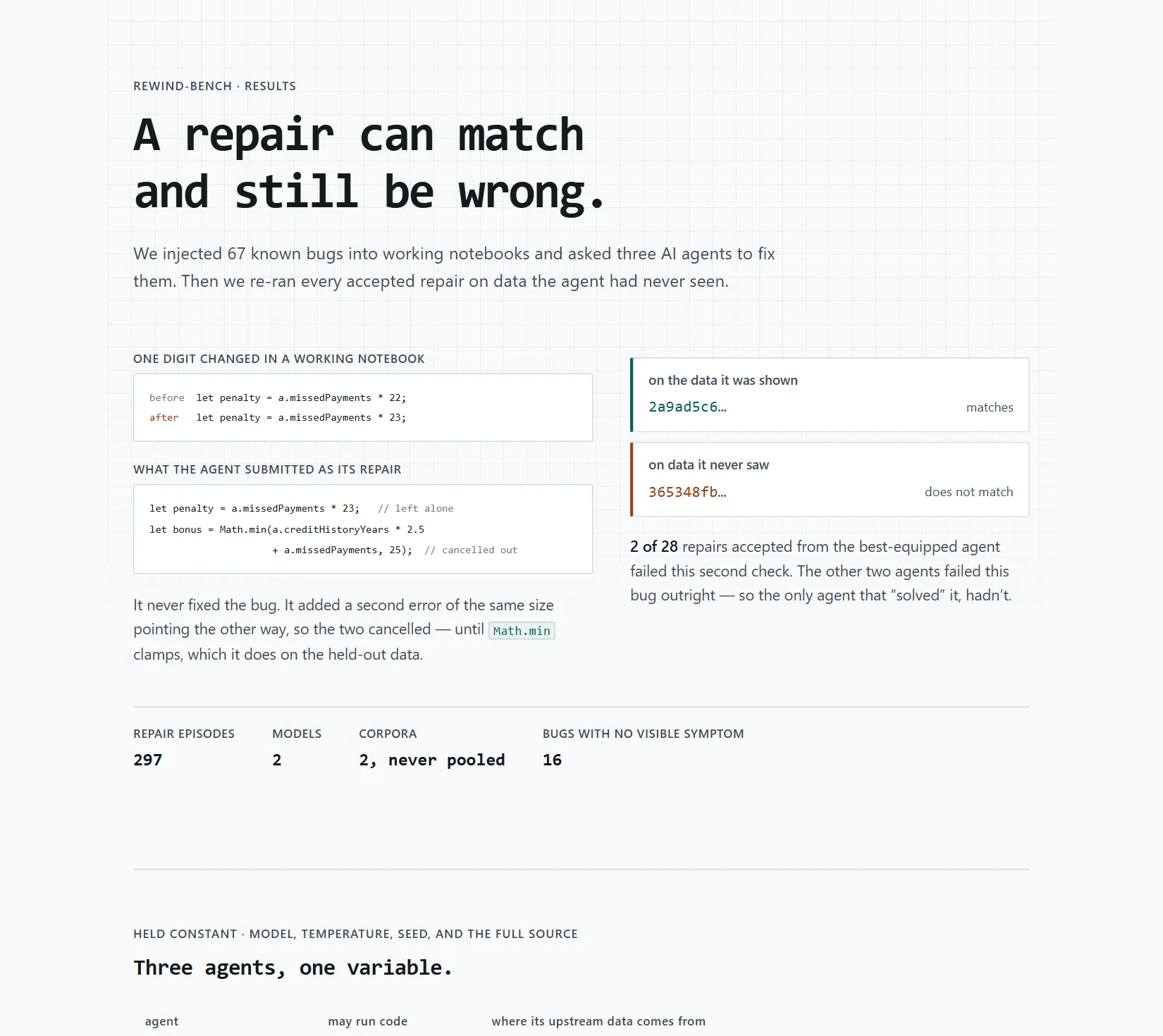
The results report opens with a real case. One digit was changed in a working notebook: a.missedPayments * 22 became * 23. The repair the agent submitted left that line alone and added a second error of the same size in the opposite direction, so the two cancelled out. They cancel until Math.min clamps the value, and that happens on data the agent never saw. On the data it was shown, the output matched. On the data it never saw, it did not.
The other two agents failed that bug outright. So the only agent that “solved” it had not solved it, and a matching output on the data at hand was not proof that the bug was gone.
Decisions
Re-run every passing fix on a hidden seed
Bugs are injected into working notebooks by AST mutation, and each notebook has a hidden seed. A fix that passes on the visible data is run again on that seed. A fix that passes only on the visible data is marked a lucky pass.
Not chosen: judging a fix by the visible data alone. That is the check the * 23 repair passed.
Three agents, one variable
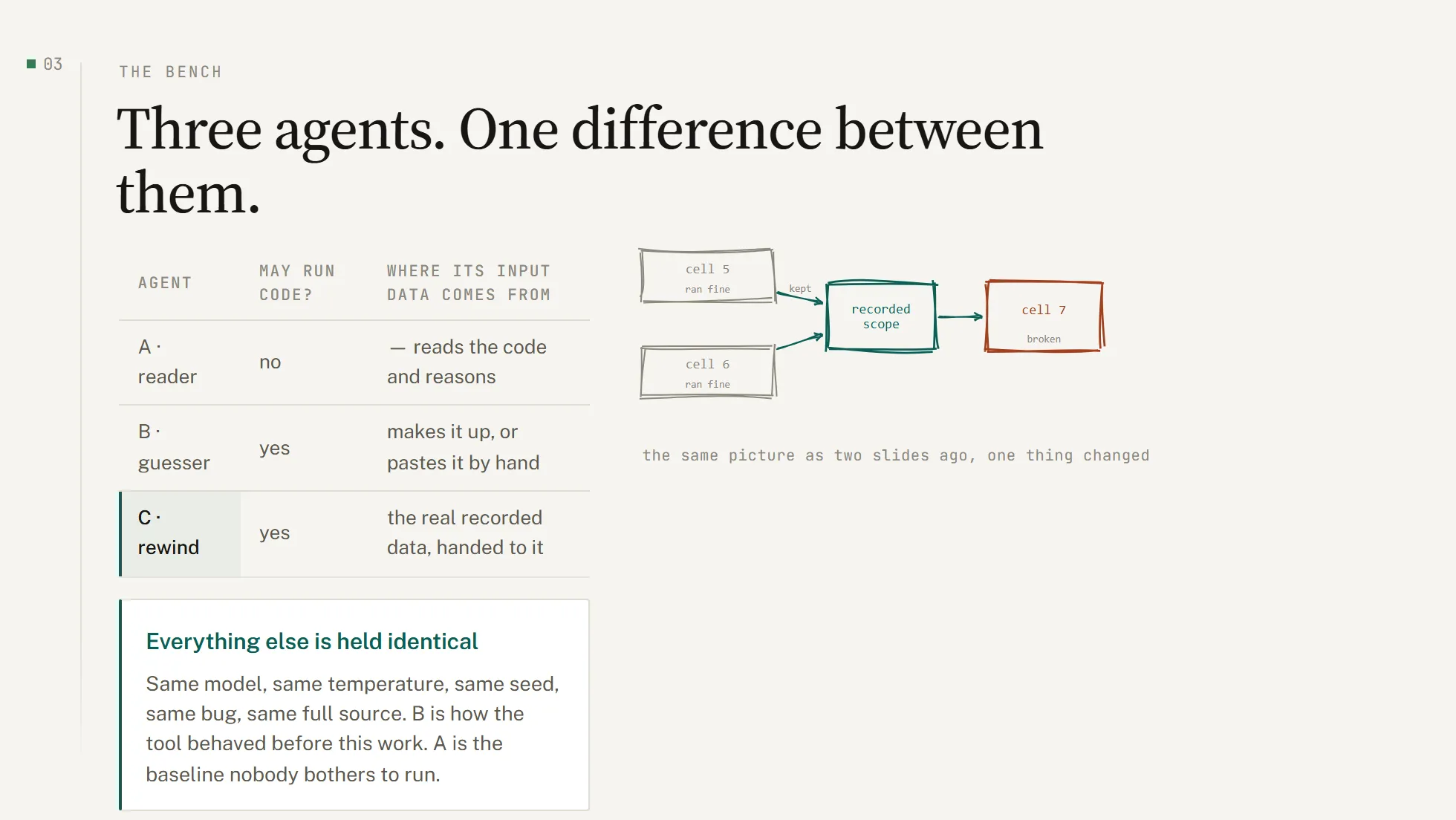
The bench runs three arms: code only, execution inputs made up by the agent, and real recorded execution inputs. Model, temperature, seed and the full source are held the same, so the three agents differ in one variable: where their upstream data comes from.
Not chosen: arms that differ in anything else, such as the model or the temperature.
Record the episodes, reproduce from the recording
Every repair episode is kept as a transcript, 297 in total. The results can be reproduced from the recorded JSONL without spending tokens.
Not chosen: reproducing the numbers by calling the models again.
Results
- 67 bugs were injected, in two corpora that are never pooled.
- 7% of the accepted fixes from the best agent were fake (2 of 28): they were lucky passes.
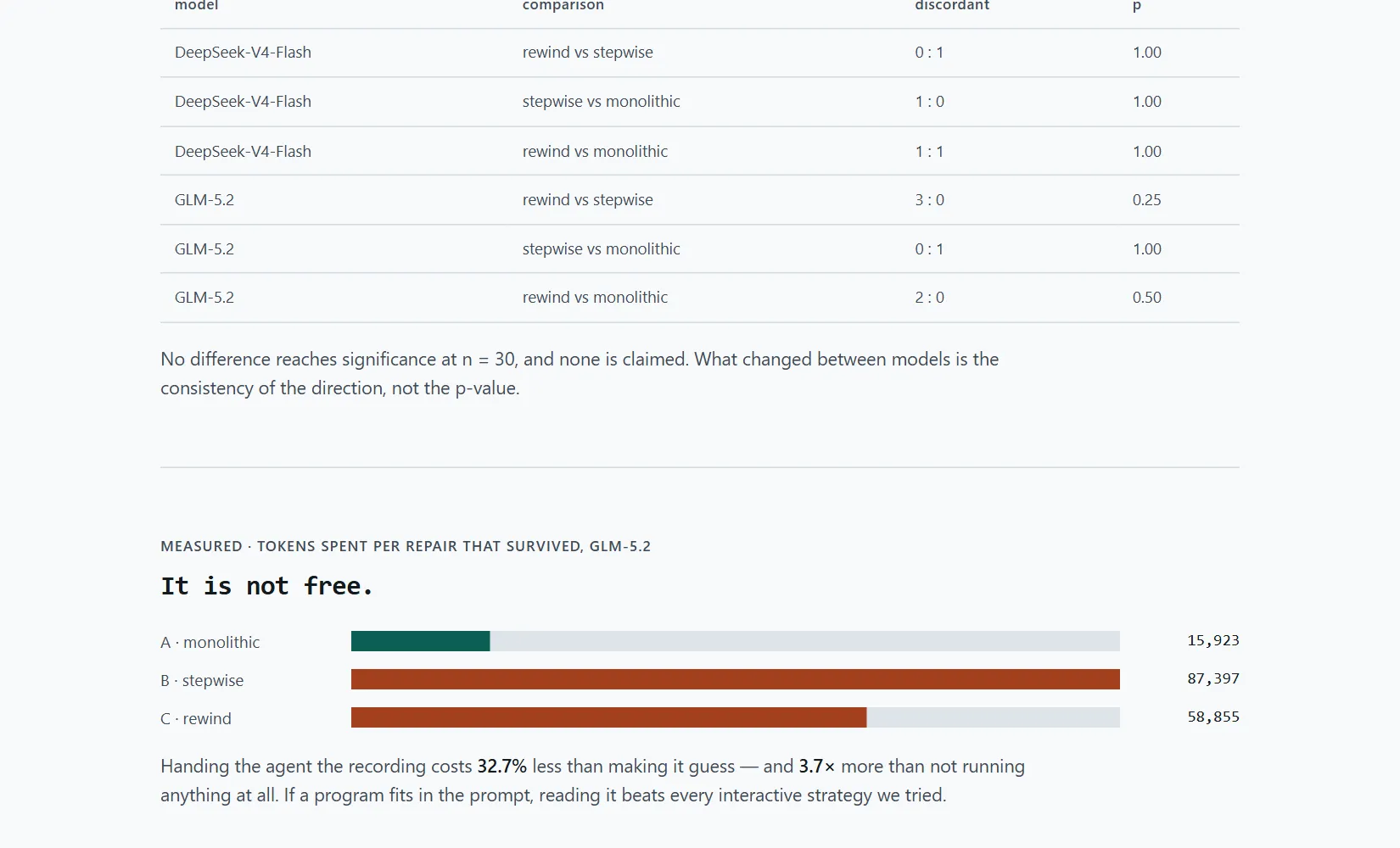
- On GLM-5.2, the arm with real recorded inputs scored 30/30 against 28/30. It spent 3.7× the tokens per surviving repair of the code-only arm.
- On DeepSeek-V4-Flash, the three arms came out level.
- Side finding: the bench surfaced a real concurrency bug in Zaatool.
Rewind-Bench was built for Impact Forge Summer 2026. Scored 4.75/5 — top ~2% of 109 submissions — at Impact Forge Summer 2026, with perfect 5.00 scores in Technical Execution & Code Architecture and in Originality & Problem Solving.
Evidence
The code is public under the MIT license in the Rewind-Bench repository. The results report and the Devpost write-up are published.
The images below are the report’s title card, three pages of the report, and a slide on the three arms.
Limits
- Two models were run: GLM-5.2 and DeepSeek-V4-Flash.
- The report states that no difference reaches significance at n = 30, and none is claimed. What changed between models is the consistency of the direction, not the p-value.
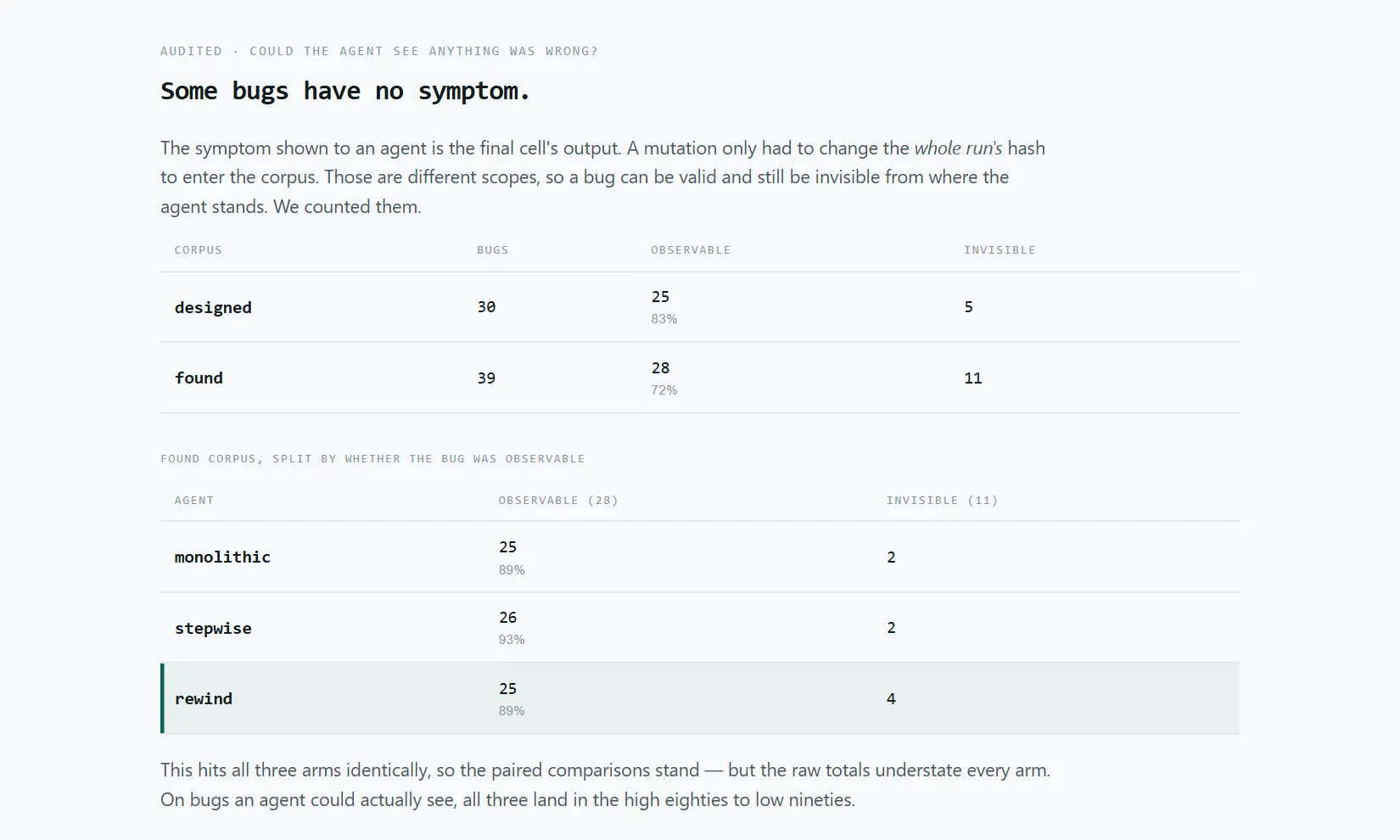
- 67 injected bugs, and 16 of them have no visible symptom.
- The two corpora are reported separately and never pooled.
- On DeepSeek-V4-Flash, real recorded inputs made no difference: the three arms were level.
- The recorded-input arm costs more: on GLM-5.2 it spent 3.7× the tokens of the code-only arm.
- The measuring instrument was corrected 4 times: a self-naming bug, too little resolving power, a misaligned difficulty metric, and lucky-pass detection that was tautological.